Napoleon once observed that "History is a lie agreed upon."
If you believe that the Allied soldiers, American and British soldiers were angels compared to the evil German and Russian soldiers; you are mistaken. (I do not talk of the cruel nuclear bombing of Hiroshima and Nagasaki nor of the terror bombing of Dresden in 1944)) World War Two did weird things to all the fighters of all nations. They too had the blood lust. Even the American and British soldiers. Below are instances when the 'good' Allied soldiers went bad. One hardly hears of them. But to be a impartial student of history one has to be single-minded in the devotion to fairness. Other wise it would not be history, but mere western propaganda.
------------------------------
Among scores of Allied witnesses interviewed for this narrative, almost every one had direct knowledge or even experience of the shooting of German prisoners during the campaign... Many British and American units shot SS prisoners routinely, which explained, as much as the fanatical resistance that the SS so often offered, why so few appeared in POW cages."
Patton wrote in his diary on 4 January 1945: "The Eleventh Armored is very green and took unnecessary losses to no effect. There were also some unfortunate incidents in the shooting of prisoners. I hope we can conceal this."
German resistance continued on into the Fall and "the discipline of even some of the finest U.S. units was cracking," including the famous 82nd and 101st Airborne Divisions. On 5 November 1944, Eisenhower's driver and girl friend, Kay Summersby, recorded: "General Betts reports that disciplinary conditions in the army are becoming bad. Many cases of rape, murder, and pillage are causing complaints by the French Dutch, etc." A month later, General Leroy Lutes remarked: "The French now grumble that the Americans are a more drunken and disorderly lot than the Germans and hope to see the day when they are liberated from the Americans." Lutes discovered that the Allied propaganda which portrayed the Germans as brutes was untrue: "I am informed the Germans did not loot either residences, stores, or museums. In fact the people claimed that they were meticulously treated by the Army of Occupation." By the end of the war, over 450 GIs were sentenced to death by courts-martial, nearly all for having committed nonmilitary offenses like rape and murder.
In sharp contrast with the picture long held up to us of American GIs being welcomed by a grateful French populace, David Irving ("War Between The Generals") is one of several historians who are casting new light on these events. It seems that far from acting like Boy Scouts out on a mission of mercy, American soldiers terrorized many of the people they were supposed to be liberating from the clutches of the nasty Nazis. As Irving informs his readers: "An ordeal began for the French who stayed behind in Normandy to welcome their liberators. They were liable to be vandalized, robbed, raped, murdered. Indeed, the behavior of GIs throughout liberated Europe was causing apprehension in Washington. The Joint Chiefs reviewed a report from Rome too that conditions now were worse than when the Germans had been there." Following a visit to Caen, B.H. Liddell Hart, the famous British military strategist and historian, pointed out that "Most Frenchmen speak of the correctness of the German Army's behavior. They seem particularly impressed that German soldiers were shot for incivility to women and compare this with the American troops' bad behavior toward women." According to an official U.S. Army report, "Unfortunately most of these undisciplined acts were caused by colored troops."
From cwporter
American author Marguerite Higgins visited Germany during the time in question and later wrote of her experiences. In her book, "News in an singular thing" she described a visit to a GI "Interrogation Center"
"The GI led us to the main door of the camp...Behind the bars of the cell we saw 3 uniformed Germans. Two of them, beaten and covered with blood, were lying unconscious on the floor. A third German was lifted up by the hair on his head, and I shall never forget, he had red hair like a carrot. A GI turned his body over and struck him in the face. When the victim groaned, the GI roared, "Shut your mouth, damned Kraut!" ....It turned out that for almost a quarter of an hour, the doubled rows of 20 to 30 GI’s stood aligned taking turns methodically beating the six captured Germans...It came out later that the worked-up GI’s had captured six young German boys, who had never even been members of the SS. The youngsters had only recently been inducted into a government work battalion. The boy with the red hair was 14 years old. The other 5 German boys in the cell blocks were between 14 and 17 years old."
WAFFEN SS POW MISTREATED BY AMERICAN SOLDIERS
(Source)
January 1945
Two members of the Waffen SS were pulled out of their camouflage holes , led
to a hollow and shot. Both of their hands were raised at the time.
A Waffen SS member, K., who was convalescing in a hospital due to a bullet
in his lungs, was shot to death by an American soldier as he was being
transferred to another hospital in the company of a Red Cross Nurse.
April 1945
Paderborn. An SS officer is ordered by his interrogators to take off his
shirt and undershirt. He is then beaten about the face and back with a whip.
An MP extinguishes his lit cigarette on the man’s back. He is then ordered
to stand with his face against a wall, while his interrogators press the
muzzle of a gun against his neck. A chain is placed around his wrist and
twisted until the man collapses from the pain.
Bavaria. A Police General is taken prisoner and led to a cell, where an
American soldier holds a pistol to his head and then urinates all over his
body.
At a special camp run by the Americans for captured SS and Nazi Party
members, a sadistic American Sergeant, Paul Doyle, brutally torments the men
under his charge. Daily he beats men into unconsciousness, often breaking
their ribs. The men are beaten so frequently and so badly that they have to be
hospitalized. One night he enters a cell and beats a man for an exceptionally
long period of time. When the victim becomes unconscious, water is thrown into
his face to revive him. He is then beaten again. Finally, he is dragged from
his cell unconscious. The man is later hospitalized for severe injuries,
internal and external. Another SS officer is so badly beaten by Doyle that he
later dies of his injuries. Another victim has his head pushed under water for
long periods of time and his buttocks so severely whipped that the skin is torn
and hanging.
An SS man is beaten repeatedly on the soles of his naked feet.
Two SS men are forced to smear each other’s face with human vomit.
Two SS men are shot to death after they surrender their arms to Americans.
Schesslitz. A deputy Ortsgruppenleiter is beaten bloody by Americans with
rubber truncheons and fists about the head. He is then compelled to eat lit
cigarettes. In a garden the form of a grave is measured out, then the man is
bound hand and foot and is left lying on the floor all night long in a room lit
by candle light. The next day the man is ordered to dig a grave and then stand
in it, while an American soldier has his picture taken defecating and urinating
in the pit.
Two SS men are spat at by an American Sergeant and then kicked in the
genitalia until they collapse.
May 1945
An SS member is burned repeatedly with cigarette butts all over his body.
An SS man is chained by his legs and hung up over a latrine with his head in
the toilet.
Altenburg. SS members are forced to completely disrobe. Americans then
whip them so badly that they lose consciousness. In that condition they are
left lying on the floor.
Herford. A severely wounded SS officer is compelled by the Americans to
carry heavy rolls of barbed wire on his naked shoulders, running at double
time. The man soon collapses when the skin from his back is ripped from his
body.
June 1945
A group of SS leaders are laden down with heavy stones and then commanded to
exercise barefoot over broken stones and gravel, until they collapse and have
to be carried away.
Two amputees are bound together with cords and forced to remain standing
without any nourishment for 48 hours. Whereupon the "interrogator"
Sergeant Wertheim quips: "Now you have two legs."
Cage 22: Prisoners are forced to clean the latrines night after night-with
their bare hands.
Cage 23: The American camp Sergeant whiles away the hours by sticking
needles into the stomachs of helpless prisoners. Note: The above occurred in
camps in France.
July 1945 Stuttgart. A man was dragged out of his bed in the middle of the
night by American soldiers because he was accused of being a member of the
Allegemeine SS.
He was dragged into the street and cudgeled. One half
hour later, he was again dragged out of his bed by 2 Americans and driven to an
open field and ordered to get out. The man refused, fearing he would be shot
in the back. Consequently he was beaten with rifle butts and fists until he
was unconscious. Water was thrown on his face and he regained consciousness,
whereby he was again beaten unconscious for a second time. As a result of the
attack he suffered broken ribs, gaping head wounds, brain damage, and loss of
teeth.
In the vicinity of Munich, Waffen SS members were forced to eat their
uniform insignias.
August 1945
In the POW camp Wolfhagen, a severely wounded SS corporal is tortured by
Americans in order to extract a confession. He is kicked in the genitals and
burned over and over again with lighted cigarettes. The young man is 20 years
old.
Weiden. POW camp. Two SS men are handcuffed to each other while
interrogators beat them. They are repeatedly struck in the kidneys.
Special
mention should be made for the Ziegenhain camp, where we have the identities of
the American inquisitors. The methods of torture used were even worse than the
above mentioned cases. The chief interrogators at this camp were Inspector
Simon, Watson, and Lieutenant Goodman. One of their favorite games was to play
"Autobahn", whereby a victim had the hair of his eyebrows and
eyelashes cut or ripped out. Later the hair was shoved into the victims mouth
or nostrils for long periods of time.
Here are a few more examples of "special
treatment":
A machine technician had his head banged into a wall so many times that
blood spurted out of his nostrils.
A man was brought in for "interrogation". He was beaten
extensively on the hands, face, neck and ears with a rubber truncheon festooned
with barbed wire. Afterwards he was struck in the face repeatedly with bare
fists. He was forced to stare in blinding lights for hours on end and
threatened with hanging or shooting. He had swastikas painted on his neck and
forehead.
A victim is forced to swallow a postcard with Hitler’s photo, along
with a burning cigarette.
A man is led into one of the torture chambers. There he is compelled to
undress and lie in vomit, urine, and filth. He is then compelled to perform
acts so disgusting that they shall not be recited here.
MASSACRES BY BRITISH SOLDIERS
NAHRENDORF (Near Hamburg, 1945)
A week after the discovery of the Belsen Concentration Camp, a rumour reached the British Army's 'Desert Rats' that the 18th SS Training Regiment of the Hitler Jugend Division, had shot their prisoners at the nearby village of Rather. The 'Rats' were engaged in a fierce battle with the SS defenders in the village of Nahrendorf. Slowly, and in groups, the SS began to surrender. As the noise of battle died away the villagers emerged from their cellars and found the bodies of 42 SS soldiers lying in a shallow grave. The bodies were then interned on a hilltop cemetery near the village. Each year, hundreds of SS veterans visit the cemetery to pay tribute to their fallen comrades whom, they say, were shot in cold blood on the orders of a ‘crazed blood-thirsty British NCO’. (Perpetrators are honoured, victims are forgotten)
The "London Cage", a MI19 prisoner of war facility in the UK during and immediately after the war, was subject to allegations of torture.
* The Dachau massacre: killing of German prisoners of war and surrendering SS soldiers at the Dachau concentration camp.
* In the Biscari massacre, which consist of two instances of mass murders, U.S. troops of the 45th Infantry Division killed roughly 75 prisoners of war, mostly Italian.
* Operation Teardrop: Eight of the surviving, captured crewmen from the sunk German submarine U-546 are tortured by US military personnel. Historian Philip K. Lundeberg has written that the beating and torture of U-546's survivors was a singular atrocity motivated by the interrogators' need to quickly get information on what the US believed were potential missile attacks on the continental US by German submarines.
In the aftermath of the Malmedy massacre a written order from the HQ of the 328th US Army Infantry Regiment, dated December 21, 1944, stated: No SS troops or paratroopers will be taken prisoner but will be shot on sight. Major-General Raymond Hufft (U.S. Army) gave instructions to his troops not to take prisoners when they crossed the Rhine in 1945. "After the war, when he reflected on the war crimes he authorized, he admitted, 'if the Germans had won, I would have been on trial at Nuremberg instead of them.'" Stephen Ambrose related: "I've interviewed well over 1000 combat veterans. Only one of them said he shot a prisoner... Perhaps as many as one-third of the veterans...however, related incidents in which they saw other GIs shooting unarmed German prisoners who had their hands up."


------------------------
Near the French village of Audouville-la-Hubert 30 German Wehrmacht prisoners were massacred by U.S. paratroopers.
Historian Peter Lieb has found that many US and Canadian units were ordered to not take prisoners during the D-Day landings in Normandy. If this view is correct it may explain the fate of 64 German prisoners (out of 130 captured) who did not make it to the POW collecting point on Omaha Beach on D-Day.
According to an article in Der Spiegel by Klaus Wiegrefe, many personal memoirs of Allied soldiers have been willfully ignored by historians until now because they were at odds with the "Greatest Generation" mythology surrounding WWII, but this has recently started to change with books such as "The Day of Battle" by Rick Atkinson where he describes Allied war crimes in Italy, and "D-Day: The Battle for Normandy," by Anthony Beevor. Beevor's latest work is currently discussed by scholars, and should some of them be proven right that means that Allied war crimes in Normandy were much more extensive "than was previously realized".
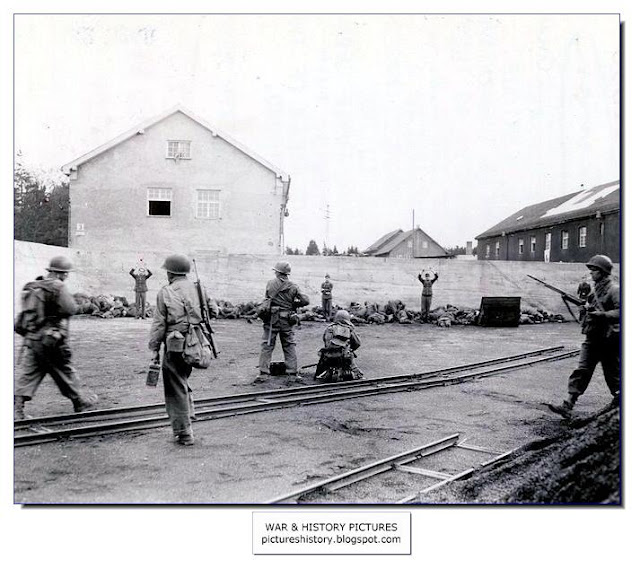
A survivor of the Dachau Massacre was Hans Linberger, who was one of the German soldiers that were forced out of the SS hospital and lined up against a wall to be shot. In the photograph below, which shows the scene of the shooting, the hospital building is on the right.
The following article about Hans Linberger was written by T. Pauli for Berkenkruis in October 1988.
Berkenkruis is the magazine of the veterans of the Flemish SS volunteers in World War II; T. Pauli was the chairman of the group in 1988 when this article was published. Pauli quoted from the testimony given to the German Red Cross by Hans Linberger.
Begin quote from article in Berkenkruis, October 1988, by T. Pauli:
Hans LINBERGER was wounded east of Kiev when an AT-gun blew away his left arm and covered his body with shrapnel. It was his fourth wound. After a long stay in the hospital he was posted to the Reserve-Kompanie at Dachau, on the 9th of March 1945.
On the 9th of April, 1945, the heavily wounded laid down their weapons; they were no longer suited to be put into action. They reported themselves to the head of the hospital, Dr. SCHRÖDER, who sent them to the barracks. Evacuated women and children were present in barrack right next to it. Preparations to be evacuated were made, doctors, staff and caretaking personnel all wore white coats and the German Red Cross-armband.
Occasional battle noise was heard from SCHLEISSHEIM that day (April 29, 1945), but around 4:30 PM things got quiet again. When suddenly single gunshots were to be heard, LINBERGER went, holding a small Red Cross-flag, to the entrance (of the hospital). (This occurred around noon.) As could be seen from his empty left sleeve, he was badly injured. To the Americans, who were pushing forward in battle-like style, he declared that this was an unarmed hospital.
One Ami (sic) placed his MP against his chest and hit him in the face. Another one said "You fight Ruski, you no good". The Ami (sic) who placed the MP (Machine Pistol) against his chest went into the hospital and immediately shot a wounded man, who fell down to the ground motionless. When SCHRÖDER wanted to surrender, he was beaten so hard that he received a skull fracture. (Ami was German slang for an American.)
The Americans drove everyone out to the main place and sorted out anyone who looked like SS. All of the SS men were then taken to the back of the central heating building and placed against the wall. A MG (Machine gun) was posted and war correspondents came to film and photograph the lined up men.
Here begins SS-Oberscharführer Hans Linberger's testimony, under oath to the DRK (German Red Cross), about the following events:
The comrade who was standing right beside me fell on top of me with a last cry - "Aww, the pigs are shooting at my stomach" - as I let myself fall immediately. To me it didn't matter if they would hit me standing or lying down. As such I only got the blood of the dead one, who was bleeding badly from the stomach, across my head and face, so I looked badly wounded. During the pause in the shooting, which can only be explained by the arrival of drunken KZ-prisoners, who, armed with spades, came looking for a man named WEISS. Several of them (the wounded soldiers) crawled forward to the Americans and tried to tell them that they were foreigners, others tried to say that they never had anything to do with the camps. Yet this man WEISS said: "Stay calm, we die for Germany". Oscha. (Oberscharführer) JÄGER asked me, while lying down, if I had been hit, which I had to deny. He was shot through the lower right arm. I quickly gave him a piece of chocolate, as we were awaiting a shot in the neck. A man wearing a Red Cross armband came to us, threw us some razor blades and said "There, finish it yourself". JÄGER cut the wrist of his shot arm, I cut the left one, and when he wanted to use the blade on me, an American officer arrived with Dr. SCHRÖDER, who could barely keep himself standing, and the shooting was stopped. This allowed us to drag away the wounded. I remember a comrade with a shot in the stomach, who came to us at Dachau, in a room of café Hörhammer, where all possible troops were mixed together. On the road, we were spit upon and cursed at by looters from the troop barracks who wished we would all be hung. During this action (sic) 12 dead were left nameless. As I later found out, documents and name tags had been removed on American orders, and a commando (work party) of German soldiers were supposed to have buried these dead in an unknown location. During the shooting, the wife of a Dr. MÜLLER, with whom I had been in correspondencer years before, had poisoned herself and her two children. I was able to find the grave of these persons. In this grave supposedly are buried 8 more SS-members, including an Oscha. MAIER. MAIER had an amputated leg and was shot in another area of the hospital terrain adjacent to the hospital wall. He lay there with a shot in his stomach and asked Miss STEINMANN to kill him, since he could not bear the pain any longer. His dying relieved Miss STEINMANN from completing the last wish of this comrade. In the proximity of the hospital/mortuary were probably other comrades executed at the walls, as I later found traces of gunfire there.
Later, as a prisoner of war, I was pointed to a grave in the same hospital terrain, by the wife of a former KZ-prisoner, who on All Saints Day in 1946 (November 1st) came near the fence and, while crying, remembered some children buried in the grave. The children must have died after the collapse (Zusammenbruch) when the Americans took over the camp. Further, comrades from the Waffen-SS are buried in the same grave, as could be concluded from a message of the Suchdienst (the German MIA tracing service).
American soldiers in the Pacific often deliberately killed Japanese soldiers who had surrendered. According to Richard Aldrich, who has published a study of the diaries kept by United States and Australian soldiers, they sometimes massacred prisoners of war. Dower states that in "many instances ... Japanese who did become prisoners were killed on the spot or en route to prison compounds." According to Aldrich it was common practice for U.S. troops not to take prisoners. This analysis is supported by British historian Niall Ferguson, who also says that, in 1943, "a secret [U. S.] intelligence report noted that only the promise of ice cream and three days leave would ... induce American troops not to kill surrendering Japanese."
Ferguson states such practices played a role in the ratio of Japanese prisoners to dead being 1:100 in late 1944. That same year, efforts were taken by Allied high commanders to suppress "take no prisoners" attitudes, among their own personnel (as these were affecting intelligence gathering) and to encourage Japanese soldiers to surrender. Ferguson adds that measures by Allied commanders to improve the ratio of Japanese prisoners to Japanese dead, resulted in it reaching 1:7, by mid-1945. Nevertheless, taking no prisoners was still standard practice among U. S. troops at the Battle of Okinawa, in April–June 1945.
Ulrich Straus, a U.S. Japanologist, suggests that frontline troops intensely hated Japanese military personnel and were "not easily persuaded" to take or protect prisoners, as they believed that Allied personnel who surrendered, got "no mercy" from the Japanese. Allied soldiers believed that Japanese soldiers were inclined to feign surrender, in order to make surprise attacks. Therefore, according to Straus, "[s]enior officers opposed the taking of prisoners[,] on the grounds that it needlessly exposed American troops to risks..." When prisoners nevertheless were taken at Gualdacanal, interrogator Army Captain Burden noted that many times these were shot during transport because "it was too much bother to take him in".
Ferguson suggests that "it was not only the fear of disciplinary action or of dishonor that deterred German and Japanese soldiers from surrendering. More important for most soldiers was the perception that prisoners would be killed by the enemy anyway, and so one might as well fight on."
U. S. historian James J. Weingartner attributes the very low number of Japanese in U.S. POW compounds to two important factors, a Japanese reluctance to surrender and a widespread American "conviction that the Japanese were "animals" or "subhuman'" and unworthy of the normal treatment accorded to POWs. The latter reason is supported by Ferguson, who says that "Allied troops often saw the Japanese in the same way that Germans regarded Russians—as Untermenschen."
Source
The "London Cage", a MI19 prisoner of war facility in the UK during and immediately after the war, was subject to allegations of torture.
MASSACRE BY AMERICANS
* The Dachau massacre: killing of German prisoners of war and surrendering SS soldiers at the Dachau concentration camp.
* In the Biscari massacre, which consist of two instances of mass murders, U.S. troops of the 45th Infantry Division killed roughly 75 prisoners of war, mostly Italian.
* Operation Teardrop: Eight of the surviving, captured crewmen from the sunk German submarine U-546 are tortured by US military personnel. Historian Philip K. Lundeberg has written that the beating and torture of U-546's survivors was a singular atrocity motivated by the interrogators' need to quickly get information on what the US believed were potential missile attacks on the continental US by German submarines.

American soldiers killing SS guards at Dachau
In the aftermath of the Malmedy massacre a written order from the HQ of the 328th US Army Infantry Regiment, dated December 21, 1944, stated: No SS troops or paratroopers will be taken prisoner but will be shot on sight. Major-General Raymond Hufft (U.S. Army) gave instructions to his troops not to take prisoners when they crossed the Rhine in 1945. "After the war, when he reflected on the war crimes he authorized, he admitted, 'if the Germans had won, I would have been on trial at Nuremberg instead of them.'" Stephen Ambrose related: "I've interviewed well over 1000 combat veterans. Only one of them said he shot a prisoner... Perhaps as many as one-third of the veterans...however, related incidents in which they saw other GIs shooting unarmed German prisoners who had their hands up."
DACHAU MASSACRE: Closeup of the bodies of SS personnel lying at the base of the tower. Their uniforms are camouflage patterned.

DACHAU MASSACRE: The photograph shows the bodies of six of the guards at the base of Tower B
DACHAU MASSACRE: SS men confer with Gen. Henning Linden during the liberation of the Dachau concentration camp. Pictured from left to right: SS aide, camp leader Untersturmführer Heinrich Wicker (mostly hidden by the aide), Paul Lévy, a Belgian journalist (person with helmet looking to the left), Dr. Victor Maurer (back), General Henning Linden (person with helmet, looking right) and some U.S. soldiers.
---------------------------
AN INQUIRY INTO A MASSACRE (From Dachau: The Hour of the Avenger : An Eyewitness Account by HOWARD A. BUECHNER)
AN INQUIRY INTO A MASSACRE (From Dachau: The Hour of the Avenger : An Eyewitness Account by HOWARD A. BUECHNER)
Date: 5 May 1945. By: Lt. Col. Joseph M. Whitaker, IGD,
Asst. Inspector General, Seventh Army.
The witness was sworn.
363 Q Please state your name, rank, serial number and organization.
A Howard E. Buchner, 1st Lieutenant, MC, 0-435481, 3rd Bn., 157th Infantry.
(The witness was advised of his rights under the 24th Article of War.)
364 Q Do you remember the taking of the Dachau Concentration Camp?
A Yes, sir.
365 Q Were you the surgeon of the 3rd Battalion, 157th Infantry, at that time?
A Yes, sir.
366 Q Did you see or visit a yard by the power plant where some German soldiers had been shot?
A I did, sir.
367 Q Can you fix the hour at which you saw this?
A Not with certainty, but I would judge about 4:00 o'clock in the afternoon.
368 Q Of what day?
A I can't give the exact date.
369 Q Describe to me what you saw when you visited this yard.
A We learned that one of our companies had gone through the camp and that it was something to see out there. So, we got on one of the peeps to visit there and we were detained for some time by the commanding officer of the 1st Battalion, 157th Infantry, because he didn't know whether the place had been cleared. When we got there we saw a quadrangular enclosure, there was a cement wall about ten feet high and inside this enclosure I saw 15 or 16 dead and wounded German soldiers lying along the wall.
370 Q Did you determine which were dead and which were wounded?
A I did not examine any of them, sir, but I saw several of them moving very slightly.
371 Q Did you make any examination to determine whether or not those who were not dead could be saved?
A I did not.
372 Q Was there any guard there?
A There was a soldier standing at the entrance of this yard whom I assumed to be a guard.
373 Q Do you know the soldier or what company he was from?
A No, sir.
374 Q Do you know whether or not any medical attention was called for these wounded German soldiers?
A I do not.
------------------------

Near the French village of Audouville-la-Hubert 30 German Wehrmacht prisoners were massacred by U.S. paratroopers.
According to an article in Der Spiegel by Klaus Wiegrefe, many personal memoirs of Allied soldiers have been willfully ignored by historians until now because they were at odds with the "Greatest Generation" mythology surrounding WWII, but this has recently started to change with books such as "The Day of Battle" by Rick Atkinson where he describes Allied war crimes in Italy, and "D-Day: The Battle for Normandy," by Anthony Beevor. Beevor's latest work is currently discussed by scholars, and should some of them be proven right that means that Allied war crimes in Normandy were much more extensive "than was previously realized".
A SURVIVOR OF THE DACHAU MASSACRE RECOLLECTS (Source)
The following article about Hans Linberger was written by T. Pauli for Berkenkruis in October 1988.
Berkenkruis is the magazine of the veterans of the Flemish SS volunteers in World War II; T. Pauli was the chairman of the group in 1988 when this article was published. Pauli quoted from the testimony given to the German Red Cross by Hans Linberger.
Begin quote from article in Berkenkruis, October 1988, by T. Pauli:
Hans LINBERGER was wounded east of Kiev when an AT-gun blew away his left arm and covered his body with shrapnel. It was his fourth wound. After a long stay in the hospital he was posted to the Reserve-Kompanie at Dachau, on the 9th of March 1945.
On the 9th of April, 1945, the heavily wounded laid down their weapons; they were no longer suited to be put into action. They reported themselves to the head of the hospital, Dr. SCHRÖDER, who sent them to the barracks. Evacuated women and children were present in barrack right next to it. Preparations to be evacuated were made, doctors, staff and caretaking personnel all wore white coats and the German Red Cross-armband.
Occasional battle noise was heard from SCHLEISSHEIM that day (April 29, 1945), but around 4:30 PM things got quiet again. When suddenly single gunshots were to be heard, LINBERGER went, holding a small Red Cross-flag, to the entrance (of the hospital). (This occurred around noon.) As could be seen from his empty left sleeve, he was badly injured. To the Americans, who were pushing forward in battle-like style, he declared that this was an unarmed hospital.
One Ami (sic) placed his MP against his chest and hit him in the face. Another one said "You fight Ruski, you no good". The Ami (sic) who placed the MP (Machine Pistol) against his chest went into the hospital and immediately shot a wounded man, who fell down to the ground motionless. When SCHRÖDER wanted to surrender, he was beaten so hard that he received a skull fracture. (Ami was German slang for an American.)
The Americans drove everyone out to the main place and sorted out anyone who looked like SS. All of the SS men were then taken to the back of the central heating building and placed against the wall. A MG (Machine gun) was posted and war correspondents came to film and photograph the lined up men.
Here begins SS-Oberscharführer Hans Linberger's testimony, under oath to the DRK (German Red Cross), about the following events:
The comrade who was standing right beside me fell on top of me with a last cry - "Aww, the pigs are shooting at my stomach" - as I let myself fall immediately. To me it didn't matter if they would hit me standing or lying down. As such I only got the blood of the dead one, who was bleeding badly from the stomach, across my head and face, so I looked badly wounded. During the pause in the shooting, which can only be explained by the arrival of drunken KZ-prisoners, who, armed with spades, came looking for a man named WEISS. Several of them (the wounded soldiers) crawled forward to the Americans and tried to tell them that they were foreigners, others tried to say that they never had anything to do with the camps. Yet this man WEISS said: "Stay calm, we die for Germany". Oscha. (Oberscharführer) JÄGER asked me, while lying down, if I had been hit, which I had to deny. He was shot through the lower right arm. I quickly gave him a piece of chocolate, as we were awaiting a shot in the neck. A man wearing a Red Cross armband came to us, threw us some razor blades and said "There, finish it yourself". JÄGER cut the wrist of his shot arm, I cut the left one, and when he wanted to use the blade on me, an American officer arrived with Dr. SCHRÖDER, who could barely keep himself standing, and the shooting was stopped. This allowed us to drag away the wounded. I remember a comrade with a shot in the stomach, who came to us at Dachau, in a room of café Hörhammer, where all possible troops were mixed together. On the road, we were spit upon and cursed at by looters from the troop barracks who wished we would all be hung. During this action (sic) 12 dead were left nameless. As I later found out, documents and name tags had been removed on American orders, and a commando (work party) of German soldiers were supposed to have buried these dead in an unknown location. During the shooting, the wife of a Dr. MÜLLER, with whom I had been in correspondencer years before, had poisoned herself and her two children. I was able to find the grave of these persons. In this grave supposedly are buried 8 more SS-members, including an Oscha. MAIER. MAIER had an amputated leg and was shot in another area of the hospital terrain adjacent to the hospital wall. He lay there with a shot in his stomach and asked Miss STEINMANN to kill him, since he could not bear the pain any longer. His dying relieved Miss STEINMANN from completing the last wish of this comrade. In the proximity of the hospital/mortuary were probably other comrades executed at the walls, as I later found traces of gunfire there.
Later, as a prisoner of war, I was pointed to a grave in the same hospital terrain, by the wife of a former KZ-prisoner, who on All Saints Day in 1946 (November 1st) came near the fence and, while crying, remembered some children buried in the grave. The children must have died after the collapse (Zusammenbruch) when the Americans took over the camp. Further, comrades from the Waffen-SS are buried in the same grave, as could be concluded from a message of the Suchdienst (the German MIA tracing service).
AMERICAN BRUTALITY IN THE PACIFIC
American soldiers in the Pacific often deliberately killed Japanese soldiers who had surrendered. According to Richard Aldrich, who has published a study of the diaries kept by United States and Australian soldiers, they sometimes massacred prisoners of war. Dower states that in "many instances ... Japanese who did become prisoners were killed on the spot or en route to prison compounds." According to Aldrich it was common practice for U.S. troops not to take prisoners. This analysis is supported by British historian Niall Ferguson, who also says that, in 1943, "a secret [U. S.] intelligence report noted that only the promise of ice cream and three days leave would ... induce American troops not to kill surrendering Japanese."
Ferguson states such practices played a role in the ratio of Japanese prisoners to dead being 1:100 in late 1944. That same year, efforts were taken by Allied high commanders to suppress "take no prisoners" attitudes, among their own personnel (as these were affecting intelligence gathering) and to encourage Japanese soldiers to surrender. Ferguson adds that measures by Allied commanders to improve the ratio of Japanese prisoners to Japanese dead, resulted in it reaching 1:7, by mid-1945. Nevertheless, taking no prisoners was still standard practice among U. S. troops at the Battle of Okinawa, in April–June 1945.
Ulrich Straus, a U.S. Japanologist, suggests that frontline troops intensely hated Japanese military personnel and were "not easily persuaded" to take or protect prisoners, as they believed that Allied personnel who surrendered, got "no mercy" from the Japanese. Allied soldiers believed that Japanese soldiers were inclined to feign surrender, in order to make surprise attacks. Therefore, according to Straus, "[s]enior officers opposed the taking of prisoners[,] on the grounds that it needlessly exposed American troops to risks..." When prisoners nevertheless were taken at Gualdacanal, interrogator Army Captain Burden noted that many times these were shot during transport because "it was too much bother to take him in".
Ferguson suggests that "it was not only the fear of disciplinary action or of dishonor that deterred German and Japanese soldiers from surrendering. More important for most soldiers was the perception that prisoners would be killed by the enemy anyway, and so one might as well fight on."
U. S. historian James J. Weingartner attributes the very low number of Japanese in U.S. POW compounds to two important factors, a Japanese reluctance to surrender and a widespread American "conviction that the Japanese were "animals" or "subhuman'" and unworthy of the normal treatment accorded to POWs. The latter reason is supported by Ferguson, who says that "Allied troops often saw the Japanese in the same way that Germans regarded Russians—as Untermenschen."
Source
AMERICAN SOLDIERS: STARVATION AT REMADEN

After the capture of the Remagen Bridge, the US Army hastily erected around 19 Prisoner of War cages around the bridge-head to hold an estimated one million prisoners. The camps were simply open fields surrounded by concertina wire. Those at the Rhine Meadows were situated at Remagen, Bad Kreuznach, Andernach, Buderich, Rheinbach and Sinzig. The German prisoners were hopeful of good treatment from the GIs but in this they were sadly disappointed. Herded into the open spaces like cattle, some were beaten and mistreated. No tents or toilets were supplied. The camps became huge latrines, a sea of urine from one end to the other. They had to sleep in holes in the ground which they dug with their bare hands. In the Bad Kreuznach cage, 560,000 men were interned in an area that could only comfortably hold 45,000. Denied enough food and water, they were forced to eat the grass under their feet and the camps soon became a sea of mud. After the concentration camps were discovered, their treatment became worse as the GIs vented their rage on the hapless prisoners.
In the five camps around Bretzenheim, prisoners had to survive on 600-850 calories per day. With bloated bellies and teeth falling out, they died by the thousands. During the two and a half months (April-May, 1945) when the camps were under American control, a total of 18,100 prisoners died from malnutrition, disease and exposure. This extremely harsh treatment at the hands of the Americans resulted in the deaths of over 50,000 German prisoners-of-war in the Rhine Meadows camps alone in the months just before and after the war ended.
Source
'SICK' BEHAVIOUR OF AMERICAN SOLDIERS
Some Allied soldiers collected Japanese body parts. The incidence of this by American personnel occurred on "a scale large enough to concern the Allied military authorities throughout the conflict and was widely reported and commented on in the American and Japanese wartime press."
The collection of Japanese body parts began quite early in the war, prompting a September 1942 order for disciplinary action against such souvenir taking. Harrison concludes that, since this was the first real opportunity to take such items (the Battle of Guadalcanal), "[c]learly, the collection of body parts on a scale large enough to concern the military authorities had started as soon as the first living or dead Japanese bodies were encountered."
When Japanese remains were repatriated from the Mariana Islands after the war, roughly 60 percent were missing their skulls.
In a memorandum dated June 13, 1944, the U.S. Army Judge Advocate General (JAG) asserted that "such atrocious and brutal policies," in addition to being repugnant, were violations of the laws of war, and recommended the distribution to all commanders of a directive pointing out that "the maltreatment of enemy war dead was a blatant violation of the 1929 Geneva Convention on the sick and wounded, which provided that: After every engagement, the belligerent who remains in possession of the field shall take measures to search for wounded and the dead and to protect them from robbery and ill treatment."

These practises were in addition also in violation of the unwritten customary rules of land warfare and could lead to the death penalty. The U.S. Navy JAG mirrored that opinion one week later, and also added that "the atrocious conduct of which some US personnel were guilty could lead to retaliation by the Japanese which would be justified under international law".
The collection of Japanese body parts began quite early in the war, prompting a September 1942 order for disciplinary action against such souvenir taking. Harrison concludes that, since this was the first real opportunity to take such items (the Battle of Guadalcanal), "[c]learly, the collection of body parts on a scale large enough to concern the military authorities had started as soon as the first living or dead Japanese bodies were encountered."
When Japanese remains were repatriated from the Mariana Islands after the war, roughly 60 percent were missing their skulls.
In a memorandum dated June 13, 1944, the U.S. Army Judge Advocate General (JAG) asserted that "such atrocious and brutal policies," in addition to being repugnant, were violations of the laws of war, and recommended the distribution to all commanders of a directive pointing out that "the maltreatment of enemy war dead was a blatant violation of the 1929 Geneva Convention on the sick and wounded, which provided that: After every engagement, the belligerent who remains in possession of the field shall take measures to search for wounded and the dead and to protect them from robbery and ill treatment."
American sailor with a Japanese skull
These practises were in addition also in violation of the unwritten customary rules of land warfare and could lead to the death penalty. The U.S. Navy JAG mirrored that opinion one week later, and also added that "the atrocious conduct of which some US personnel were guilty could lead to retaliation by the Japanese which would be justified under international law".
THE DACHAU KILLINGS (April, 1945)
The Dachau Concentration Camp, near Munich, was liberated by US forces on the 29th. of April, 1945. First to enter the camp and confront the horror within was Private First Class John Degro, the lead scout of Company 1, 3rd Battalion, 157 Infantry Regiment, 45th Division of the US 7th Army. Prior to entering the camp, the troops had come upon a train of thirty nine cattle trucks parked just outside the camp. The train had come from Auschwitz in Poland after a journey of thirty days. The trucks were filled with the corpses of 2,310 Hungarian and Polish Jews who had died from hunger and thirst. Enraged, the Americans rounded up most of the SS guard complement of 560 men, hundreds of whom had already deserted. Included in the round-up was a detachment from the 5th SS Panzer 'Viking' Division sent to Dachau earlier to maintain security and replace those who had deserted. Guarded by angry GIs, one group of guards were lined up against a wall to await the appearance of their commander, SS Obersturmfüher Heindrich Skodzensky.
When he appeared, dressed immaculately with polished boots, and giving the military salute, which was ignored by the US company commander, Lt. William Jackson, who ordered "Line this piece of shit up with the rest of 'em over there". The GIs lost control and began shouting 'Kill em, kill em'. Filled with murderous rage and with tears streaming down his face, one GI of the 15th Infantry Regiment, opened fire with his machine-gun. After three bursts of raking fire, a total of 122 SS men lay dead or dying along the base of the wall. A few of the camp inmates, dressed in the familiar striped clothing and armed with .45 caliber pistols, then walked along the line of dead and dying guards and administrated the coup de grace to those still alive. Forty other guards were killed by revengeful inmates, some having their arms and legs torn apart. At another site near the SS hospital, hundreds of German guards were machine gunned to death on the orders of the executive officer of Company 1, 3rd Battalion. Altogether, a total of 520 persons, acting as camp and tower guards, including many Hungarians in German uniforms and recently returned from the Eastern Front, were killed that day. The sad fact is that many of these guards were new arrivals at the camp and were not the real culprits, the truly guilty had already fled. (Controversy rages to this day over just how many camp guards were killed at Dachau and different units of the US Army are still claiming the title 'First Liberators')
THE WEBLING ATROCITY (April, 1945)
This city of culture is situated on both sides of the Elbe river. Of no tactical or strategic value to the German war effort it was considered 'safe' from destruction by air attacks. By 1945 it became a shelter for some 350,000 refugees fleeing from the approaching Red Army. At the Yalta conference Stalin requested more action against cities such as Berlin, Leipzig and Chemnitz. No mention was made of Dresden. The fact that Dresden was chosen was because the Russians at that time were only fifty kilometres away from the city, much nearer to Dresden than than they were to Berlin, Leipzig or Chemnitz. No doubt Churchill was eager to impress the Soviet leader, Stalin. RAF and USAAF bombers devastated the city in the most concentrated incendiary attack of the war in Europe (Operation Thunderclap) In all, 733 British bombers dropped 1,478 tons of high explosive bombs and 1,182 tons of incendiary bombs and 311 US Flying Fortresses dropped 771 tons of bombs on the city. Around 35,000 persons were reported as 'missing' after the fire-storm which engulfed the city and destroyed eleven square miles of its center including 14,000 houses, 22 hospitals, 72 schools and 31 department stores. By the 10th of March, 18,375 dead and 2,212 seriously injured were accounted for. The final death toll was expected to reach 25,000.
 In one of the city squares 6,865 bodies were cremated. Thousands of British and American prisoners-of-war were on work detail in the city from the large POW camp Stalag IVb at nearby Muehlberg. Casualties among the prisoners were fewer than a hundred. Around 200,000 refugees from the east were camped in the city's 'Grosser Garten'. It was estimated that about 1,300,000 people were in the city as the raid started. The toll would have been much higher had not some bomber crews, knowing that thousands of refugees were in the city, deliberately jettisoned their bomb loads wide of the mark. It is doubtful that the air attack on Dresden shortened the war by even one day. At this point of the war, Germany was on the brink of collapse so why give the still twitching corpse this one final brutal kick? Churchill was later to say "The destruction of Dresden remains a serious query against the conduct of Allied bombing". In 1956, Dresden in Germany and Coventry in England, (1,236 deaths) entered a twin-town relationship. (In 1956, the German Statistical Office estimated that German civilian dead, due to air raids throughout the war, to be around 410,000)
The merciless revenge perpetrated on the entire German civilian population of Eastern Europe during the closing stages of the war, and for many months after, took the lives of over 2,100,000 ethnic German men, women and children. For generations these Germans had lived and toiled in areas that today are part of central and Eastern Europe. Around fifteen million of these Volksdeutsche were driven from their homes and ancestral lands in Poland, East Prussia, Silesia, Ukraine, Belarus and Serbia and forced back into the Allied occupied zones of Germany.
This was the greatest forcible evacuation of people in European history. It is estimated that of the eight million Germans expelled from Poland around 1,600,000 died in the process. In Czechoslovakia, memories of the Lidice massacre inspired acts of revenge against German soldiers and civilians. Soldiers were disarmed, tied to stakes, doused with petrol and set alight. Wounded German soldiers in hospital were shot in their beds, others were hung up on lamposts in Wenzell Square and fires were lit beneath them so that they died the gruesome death of being roasted alive. These ethnic Germans lived in fear of the Russians but no one thought that the dreadful fate which awaited them would not even emanate from the Soviets at all but from their own neighbours, the Czechs!
Thousands of innocent German residents were murdered in their homes by the Czechs, others were forced into interment camps where they were beaten and maltreated before being expelled. Bishop Beranek of Prague declared: 'If a Czech comes to me and confesses to having killed a German, I absolve him immediately'. The Americans, utterly blind to the political consequences of allowing the Soviets to liberate Czechoslovakia, halted at the Karlsbad-Pilsen-Budweis line. The Sudeten Germans now had no protection from the torrent of bestiality vented on them by the Czechs. In Brno, 25,000 German civilians were forced marched at gun-point to the Austrian border. There, the Austrian guards refused them entry, the Czech guards refused to re-admit them. Herded into an open field they died by the hundreds from hunger and cold before being rescued by the US 16th Tank Division on May 8th 1945. In the Russian occupied zones of Eastern Europe and in Germany, hundreds of thousands of civilian men and women, Poles, Czechs, Romanians and Germans, were transported to the Urals in the Soviet Union and used as slave labourers until released in the late 40s. Mostly ignored by the world's press, the unimaginable suffering experienced by the expellees is largely unknown outside Germany, yet it was systematically carried out in a brutal fashion as official Allied policy in accordance with the decisions formulated at Yalta and Potsdam.
Monte Cassino fell to the Allies on May 18, 1944. After a four month struggle and the abbey bombed into ruins by the US Air Force, Polish troops of the 12th Lancers, 3rd Carpathian Division, raised their regimental flag over the ruins of the 6th century Benedictine Monastery situated high in the Apennines of central Italy. The next night thousands of French Moroccan, Algerian, Tunisian and Senegalese troops, attached to the French Expeditionary Corps, swarmed over the slopes of the hills surrounding Monte Cassino and in the villages of Ciociaria and Esperia, which is in the region of Lazio, raped every woman and girl that came within their sight. Over 2,000 women, ranging in age from 11 years to 86 years suffered at the hands of these gang-raping soldiers as village after village was entered. Menfolk who tried to protect their wives and daughters were murdered without mercy, around 800 of them died. Two sisters aged 15 and 18 were raped by dozens of soldiers each. One died from the abuse, the other was still in a mental hospital in 1997, 53 years after the event. Most of the dwellings in the villages were destroyed and everything of value was stolen.
Later in the war, these same troops raped around 500 women in the Black Forrest town of Freudenstadt, on April 17, 1945, after its capture. In Stuttgart, colonial French troops, mostly African, but under the command of General Eisenhower, rounded up around 2,000 women and herded them into the underground subways to be raped. In one week more women were raped in Stuttgart than in the whole of France during the four year German occupation.
On the same day that the Dachau Concentration Camp was discovered, a massacre took place in the little hamlet of Webling about ten kilometres from the camp. A Waffen-SS unit had arrived at the hamlet, which consisted of about half a dozen farm houses, barns and the Chapel of St. Leonhard, to take up defensive positions in trenches dug around the farms by French P.O.W. workers. Their orders were to delay the advance of American tanks of the 20th Armoured Division and infantry units of the 7th US Army which was approaching Dachau.
The farms, mostly run by women (whose husbands were either dead, prisoners of war or still fighting) with the help of French POWs, came under fire on the morning of 29th April causing all inhabitants to rush for the cellars. One soldier of Company F of the US 222nd Infantry Regiment of the 42nd Rainbow Division, was killed as they entered the hamlet under fire from the Waffen-SS unit. The first German to emerge from the cellar was the owner of the farm, Herr Furtmayer. Informed by the French POWs that only civilians, not SS, were in hiding in the cellers, the GIs proceeded to round up the men of the SS unit.
First to surrender was an officer, Freiherr von Truchsess, heading a detachment of seventeen men. The officer was immediately struck with a trenching tool splitting his head open. The other seventeen were lined up in the farmyard and shot. On a slight rise behind the hamlet, another group of eight SS were shot. Their bodies were found lying in a straight line with their weapons and ammunition belts neatly laid on the ground. This would suggest that the men were shot after they surrendered. Altogether, one SS officer and forty one men lay dead as the infantry regiment proceeded on their way towards Dachau. Next day the local people, with the help of the French POWs, buried the bodies in a field to be later exhumed by the German War Graves Commission and returned to their families.
DRESDEN (February 13/14, 1945)
This city of culture is situated on both sides of the Elbe river. Of no tactical or strategic value to the German war effort it was considered 'safe' from destruction by air attacks. By 1945 it became a shelter for some 350,000 refugees fleeing from the approaching Red Army. At the Yalta conference Stalin requested more action against cities such as Berlin, Leipzig and Chemnitz. No mention was made of Dresden. The fact that Dresden was chosen was because the Russians at that time were only fifty kilometres away from the city, much nearer to Dresden than than they were to Berlin, Leipzig or Chemnitz. No doubt Churchill was eager to impress the Soviet leader, Stalin. RAF and USAAF bombers devastated the city in the most concentrated incendiary attack of the war in Europe (Operation Thunderclap) In all, 733 British bombers dropped 1,478 tons of high explosive bombs and 1,182 tons of incendiary bombs and 311 US Flying Fortresses dropped 771 tons of bombs on the city. Around 35,000 persons were reported as 'missing' after the fire-storm which engulfed the city and destroyed eleven square miles of its center including 14,000 houses, 22 hospitals, 72 schools and 31 department stores. By the 10th of March, 18,375 dead and 2,212 seriously injured were accounted for. The final death toll was expected to reach 25,000.
THE EXPULSION TRAGEDY
The merciless revenge perpetrated on the entire German civilian population of Eastern Europe during the closing stages of the war, and for many months after, took the lives of over 2,100,000 ethnic German men, women and children. For generations these Germans had lived and toiled in areas that today are part of central and Eastern Europe. Around fifteen million of these Volksdeutsche were driven from their homes and ancestral lands in Poland, East Prussia, Silesia, Ukraine, Belarus and Serbia and forced back into the Allied occupied zones of Germany.
This was the greatest forcible evacuation of people in European history. It is estimated that of the eight million Germans expelled from Poland around 1,600,000 died in the process. In Czechoslovakia, memories of the Lidice massacre inspired acts of revenge against German soldiers and civilians. Soldiers were disarmed, tied to stakes, doused with petrol and set alight. Wounded German soldiers in hospital were shot in their beds, others were hung up on lamposts in Wenzell Square and fires were lit beneath them so that they died the gruesome death of being roasted alive. These ethnic Germans lived in fear of the Russians but no one thought that the dreadful fate which awaited them would not even emanate from the Soviets at all but from their own neighbours, the Czechs!
Thousands of innocent German residents were murdered in their homes by the Czechs, others were forced into interment camps where they were beaten and maltreated before being expelled. Bishop Beranek of Prague declared: 'If a Czech comes to me and confesses to having killed a German, I absolve him immediately'. The Americans, utterly blind to the political consequences of allowing the Soviets to liberate Czechoslovakia, halted at the Karlsbad-Pilsen-Budweis line. The Sudeten Germans now had no protection from the torrent of bestiality vented on them by the Czechs. In Brno, 25,000 German civilians were forced marched at gun-point to the Austrian border. There, the Austrian guards refused them entry, the Czech guards refused to re-admit them. Herded into an open field they died by the hundreds from hunger and cold before being rescued by the US 16th Tank Division on May 8th 1945. In the Russian occupied zones of Eastern Europe and in Germany, hundreds of thousands of civilian men and women, Poles, Czechs, Romanians and Germans, were transported to the Urals in the Soviet Union and used as slave labourers until released in the late 40s. Mostly ignored by the world's press, the unimaginable suffering experienced by the expellees is largely unknown outside Germany, yet it was systematically carried out in a brutal fashion as official Allied policy in accordance with the decisions formulated at Yalta and Potsdam.
RAMPAGE ON MONTE CASSINO
Monte Cassino fell to the Allies on May 18, 1944. After a four month struggle and the abbey bombed into ruins by the US Air Force, Polish troops of the 12th Lancers, 3rd Carpathian Division, raised their regimental flag over the ruins of the 6th century Benedictine Monastery situated high in the Apennines of central Italy. The next night thousands of French Moroccan, Algerian, Tunisian and Senegalese troops, attached to the French Expeditionary Corps, swarmed over the slopes of the hills surrounding Monte Cassino and in the villages of Ciociaria and Esperia, which is in the region of Lazio, raped every woman and girl that came within their sight. Over 2,000 women, ranging in age from 11 years to 86 years suffered at the hands of these gang-raping soldiers as village after village was entered. Menfolk who tried to protect their wives and daughters were murdered without mercy, around 800 of them died. Two sisters aged 15 and 18 were raped by dozens of soldiers each. One died from the abuse, the other was still in a mental hospital in 1997, 53 years after the event. Most of the dwellings in the villages were destroyed and everything of value was stolen.
Later in the war, these same troops raped around 500 women in the Black Forrest town of Freudenstadt, on April 17, 1945, after its capture. In Stuttgart, colonial French troops, mostly African, but under the command of General Eisenhower, rounded up around 2,000 women and herded them into the underground subways to be raped. In one week more women were raped in Stuttgart than in the whole of France during the four year German occupation.
ALLIED ATROCITIES
Allied troops, as well as Axis troops, committed terrible atrocities during the war. Some years after the war a mass grave was discovered just west of the city of Nuremberg. In it were the bodies of some 200 SS soldiers. It was not until 1976 that one of the bodies was positively identified. It was the body of SS Hauptsturmfuhrer Kukula, the commander of the 1st Battalion, 38th SS Panzer Grenadier Regiment. Autopsies on the other bodies showed that most had been shot at close range, the others beaten to death by the rifle butts of the US Seventh Army GIs. In the village of Eberstetten, 17 German soldiers of the 'Gotz von Berlichingen' Division were shot after they surrendered to US troops.
On April 8, 1945, fourteen members of the 116th Panzer Division were marched through the streets of Budberg to the command post of the US 95th Infantry Division. There, they were lined up and shot. Three were wounded but managed to escape.
On April 13, 1945, tanks of the US 97th or 78th Infantry Division were approaching the village of Spitze about fifteen miles east of Cologne. They came under fire from a 8.8 anti-tank gun which disabled one of the tanks. That night, the village was pounded by tank and artillery fire and at daybreak the US forces entered the village. All the inhabitants, about eighty, were gathered together in front of the church. Included in the eighty were twenty German soldiers, members of an anti-aircraft unit stationed in the village. They were separated from the civilians and marched several hundred yards to a field just outside the village. There, they were lined up and mowed down by machine-gun fire. Next day the US Army ordered the civilians to dig graves and bury the dead. On April 14, 1995, a memorial for the twenty victims was built near the spot.
At the village of Chenogne in Belgium a group of twenty-one German soldiers emerged from a burning building carrying a Red Cross flag. Their intention was to surrender to the US forces but as they exited the doorway they were shot down by machine-gun and small arms fire. This happened soon after the Malmedy Massacre on December 17, 1944.
During the Allied assault on Sicily, the largest of the Mediterranean islands, (July, 1943) a dozen unarmed civilians, including some children, were apprehended by US troops after the town of Canicatti surrendered. The civilians were reported to be looting after they had entered a bombed out soap and food factory and were filling buckets with liquid soap that had spilled on the ground. At around 6pm, when an American officer, a lieutenant-colonel, and a group Military Police, accompanied by three interpreters, entered the factory the officer fired a series of shots from his automatic Colt-45 point blank into the crowd. He reloaded and fired again. Eight of the civilians, including an eleven year old girl, died. The officer and soldiers then drove off. Fearing reprisals from the residents of the town, the incident was hushed up for over sixty years. Due to the efforts of Dr. Joseph S. Salemi of New York University, this atrocity was brought to light. The perpetrator of this crime, Lieutenant Colonel McCaffery, died in 1954.
During the fighting at Leonforte in July 1943, according to Mitcham and von Stauffenberg in the book The Battle of Sicily, The Loyal Edmonton Regiment killed captured German prisoners.
Kurt Meyer, of the 12th SS Panzer Division Hitlerjugend, accused Canadian forces of the 3rd Canadian Infantry Division during the 1944 Normandy campaign of breaching the Hague Conventions. He claims that on 7 June notes were found that ordered no prisoners to be taken, information confirmed by Canadian infantry under interrogation; that prisoners were not to be taken if they hindered operations. Hubert Meyer also confirms this story; he states that on 8 June a Canadian notebook was found that contained orders to not take prisoners if they impeded the attacking force. Kurt Meyer also calls upon evidence from Bernhard Siebken’s war crimes trial during which the allegation was made that Canadian infantry shot, on at least one occasion, German soldiers who had surrendered during the campaign.
C.P. Stacey, the Canadian official campaign historian, reports that on 14 April 1945 rumours had been spread that the commanding officer of the Argyll and Sutherland Highlanders of Canada had been killed by a civilian sniper; this resulted in the highlanders setting fire to civilian property within the town of Friesoythe in a case of reprisal. Stacey later wrote that the highlanders first removed German civilians from their property before setting the houses on fire, he commented that he was "glad to say that [he] never heard of another such case".
Wikipedia
On April 8, 1945, fourteen members of the 116th Panzer Division were marched through the streets of Budberg to the command post of the US 95th Infantry Division. There, they were lined up and shot. Three were wounded but managed to escape.
On April 13, 1945, tanks of the US 97th or 78th Infantry Division were approaching the village of Spitze about fifteen miles east of Cologne. They came under fire from a 8.8 anti-tank gun which disabled one of the tanks. That night, the village was pounded by tank and artillery fire and at daybreak the US forces entered the village. All the inhabitants, about eighty, were gathered together in front of the church. Included in the eighty were twenty German soldiers, members of an anti-aircraft unit stationed in the village. They were separated from the civilians and marched several hundred yards to a field just outside the village. There, they were lined up and mowed down by machine-gun fire. Next day the US Army ordered the civilians to dig graves and bury the dead. On April 14, 1995, a memorial for the twenty victims was built near the spot.
------------------------
At the village of Chenogne in Belgium a group of twenty-one German soldiers emerged from a burning building carrying a Red Cross flag. Their intention was to surrender to the US forces but as they exited the doorway they were shot down by machine-gun and small arms fire. This happened soon after the Malmedy Massacre on December 17, 1944.
-----------------------------
During the Allied assault on Sicily, the largest of the Mediterranean islands, (July, 1943) a dozen unarmed civilians, including some children, were apprehended by US troops after the town of Canicatti surrendered. The civilians were reported to be looting after they had entered a bombed out soap and food factory and were filling buckets with liquid soap that had spilled on the ground. At around 6pm, when an American officer, a lieutenant-colonel, and a group Military Police, accompanied by three interpreters, entered the factory the officer fired a series of shots from his automatic Colt-45 point blank into the crowd. He reloaded and fired again. Eight of the civilians, including an eleven year old girl, died. The officer and soldiers then drove off. Fearing reprisals from the residents of the town, the incident was hushed up for over sixty years. Due to the efforts of Dr. Joseph S. Salemi of New York University, this atrocity was brought to light. The perpetrator of this crime, Lieutenant Colonel McCaffery, died in 1954.
CANADIANS
During the fighting at Leonforte in July 1943, according to Mitcham and von Stauffenberg in the book The Battle of Sicily, The Loyal Edmonton Regiment killed captured German prisoners.
Kurt Meyer, of the 12th SS Panzer Division Hitlerjugend, accused Canadian forces of the 3rd Canadian Infantry Division during the 1944 Normandy campaign of breaching the Hague Conventions. He claims that on 7 June notes were found that ordered no prisoners to be taken, information confirmed by Canadian infantry under interrogation; that prisoners were not to be taken if they hindered operations. Hubert Meyer also confirms this story; he states that on 8 June a Canadian notebook was found that contained orders to not take prisoners if they impeded the attacking force. Kurt Meyer also calls upon evidence from Bernhard Siebken’s war crimes trial during which the allegation was made that Canadian infantry shot, on at least one occasion, German soldiers who had surrendered during the campaign.
C.P. Stacey, the Canadian official campaign historian, reports that on 14 April 1945 rumours had been spread that the commanding officer of the Argyll and Sutherland Highlanders of Canada had been killed by a civilian sniper; this resulted in the highlanders setting fire to civilian property within the town of Friesoythe in a case of reprisal. Stacey later wrote that the highlanders first removed German civilians from their property before setting the houses on fire, he commented that he was "glad to say that [he] never heard of another such case".
Wikipedia
------------------------------------------
AMERICANS KILLED MEN OF SS TOTENKOPF IN 1945
When the Totenkopf surrendered (to the Americans) they were turned over to the Soviets Linz in 1945. Those who were wounded or simply too exhausted to make it to Pregarten were executed by the Americans along the way (some 80 in all suffered this fate).
MORE ON THE DACHAU MASSACRE, APRIL 29, 1945
The incident was investigated by Lt. Col. Joseph Whitaker, the Seventh Army's Assistant Inspector General. A report on the "Investigation of Alleged Mistreatment of German Guards at Dachau" was filed on June 8, 1945. It was marked secret, but the contents were later revealed to the public in 1991. A copy of the report is included in Col. John H. Linden's book "The Surrender of Dachau 29 April 1945."
The paragraphs below, from the Secret Report, pertain to the Execution of German soldiers by members of the 45th Division.
Dan Dougherty was a 19-year-old soldier with C Company, which was ordered to relieve I Company after the SS soldiers were killed. In an interview in April 2005 with Jennifer Upshaw, Assistant City Editor of the Marin Independent Journal in Marin County, California, Dougherty said that the men of I company had "gone berserk" under the strain.
"They became very emotional, crying," Dougherty said. "We went in to relieve them. They'd walked along that same train of boxcars. We came to the coal yard. It was a strange sight because here are about 10 reporters standing in this courtyard around corpses of SS officers." An estimated 200 to 300 SS guards were rounded up - two to three dozen were "killed unnecessarily," Dougherty said. "I Company, we now know they got there about noon and at 2 p.m. arrived at the southwest corner and worked over to the east side where the prison was. They were holding the prisoners of war in the coal yard. We know there something happened. About 17 (guards) were shot." Dougherty said he has learned through his research a U.S. Army private insisted the group had fired at the guards in self defense, although the company's commanding officer said the group was not provoked. "I think it haunted some of them," he said. No one was ever charged with a crime, he said.
Herbert Stolpmann was a German POW who worked for the US military at Dachau after the liberation. In an e-mail letter to me, Stolpmann wrote:
When American Troops "liberated" Camp Dachau proper, they forced all the SS-families, including women and children, out of the so-called villas, put their fathers against the wall and shot them. Most of the mothers had cyanide capsules; they gave them to their children and told them, put them into their mouths, bite onto them as soon as Daddy is shot. The American "Liberators" stopped the shooting after about 24 children were dead.
The American soldiers who were involved in the Dachau massacre were court-martialled, but the papers were torn up and then burned by General George S. Patton, Commander of the US Third Army. The Dachau massacre was kept secret until 1991 when information was finally released.
Dan Dougherty was a 19-year-old soldier with C Company, which was ordered to relieve I Company after the SS soldiers were killed. In an interview in April 2005 with Jennifer Upshaw, Assistant City Editor of the Marin Independent Journal in Marin County, California, Dougherty said that the men of I company had "gone berserk" under the strain.
"They became very emotional, crying," Dougherty said. "We went in to relieve them. They'd walked along that same train of boxcars. We came to the coal yard. It was a strange sight because here are about 10 reporters standing in this courtyard around corpses of SS officers." An estimated 200 to 300 SS guards were rounded up - two to three dozen were "killed unnecessarily," Dougherty said. "I Company, we now know they got there about noon and at 2 p.m. arrived at the southwest corner and worked over to the east side where the prison was. They were holding the prisoners of war in the coal yard. We know there something happened. About 17 (guards) were shot." Dougherty said he has learned through his research a U.S. Army private insisted the group had fired at the guards in self defense, although the company's commanding officer said the group was not provoked. "I think it haunted some of them," he said. No one was ever charged with a crime, he said.
---------------------------------
In a previous interview with
Ronnie Cohen of the Jewish Weekly News of Northern California
in April 2001, Dougherty said that, soon after he arrived at
Dachau, he had seen about 10 reporters staring at a pile of corpses.
The following is a quote from Dougherty in this article:
"This mound of corpses was about
2 or 3 feet high and 15 feet across. And they were SS. One of
the corporals in my company whips out a hunting knife and cuts
a finger off one of the bodies. He wanted an SS ring for a souvenir."Herbert Stolpmann was a German POW who worked for the US military at Dachau after the liberation. In an e-mail letter to me, Stolpmann wrote:
When American Troops "liberated" Camp Dachau proper, they forced all the SS-families, including women and children, out of the so-called villas, put their fathers against the wall and shot them. Most of the mothers had cyanide capsules; they gave them to their children and told them, put them into their mouths, bite onto them as soon as Daddy is shot. The American "Liberators" stopped the shooting after about 24 children were dead.
The American soldiers who were involved in the Dachau massacre were court-martialled, but the papers were torn up and then burned by General George S. Patton, Commander of the US Third Army. The Dachau massacre was kept secret until 1991 when information was finally released.
Source
------------------------------------------------
KILLINGS BY BRITISH SOLDIERS: NAHRENDORF
(Near Hamburg. 1945) A week after the discovery of the Belsen Concentration Camp, the news reached the British Army's 'Desert Rats' that the 18th SS Training Regiment of the Hitler Jugend Division, had shot their prisoners at nearby Rethem. The 'Rats' were engaged in a fierce battle with the SS defenders in the village of Nahrendorf. Slowly, and in groups, the SS began to surrender. As the noise of battle died away the villagers emerged from their cellars and found the bodies of 42 SS soldiers lying in a shallow grave. The bodies were then interned on a hilltop cemetery near the village. Each year, hundreds of SS veterans visit the cemetery to pay tribute to their fallen comrades whom, they say, were shot in cold blood on the orders of a ‘crazed blood-thirsty British NCO’.
Source: Compunews
Source: Compunews
---------------------------------------------
THE FRENCH PEOPLE THOUGHT THE GERMANS WERE BETTER........
German resistance continued on into the Fall and "the discipline of even some of the finest U.S. units was cracking," including the famous 82nd and 101st Airborne Divisions. On 5 November 1944, Eisenhower's driver and girl friend, Kay Summersby, recorded: "General Betts reports that disciplinary conditions in the army are becoming bad. Many cases of rape, murder, and pillage are causing complaints by the French Dutch, etc." A month later, General Leroy Lutes remarked: "The French now grumble that the Americans are a more drunken and disorderly lot than the Germans and hope to see the day when they are liberated from the Americans." Lutes discovered that the Allied propaganda which portrayed the Germans as brutes was untrue: "I am informed the Germans did not loot either residences, stores, or museums. In fact the people claimed that they were meticulously treated by the Army of Occupation." By the end of the war, over 450 GIs were sentenced to death by courts-martial, nearly all for having committed nonmilitary offenses like rape and murder.



